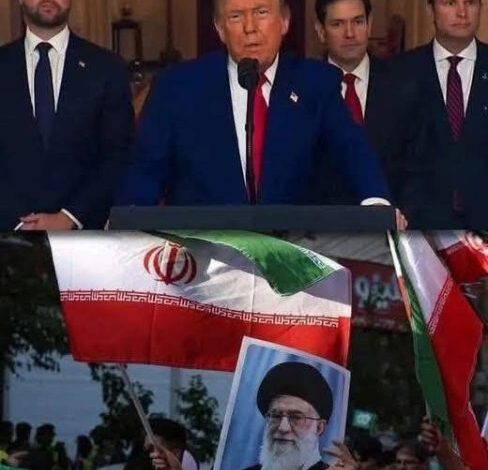
The first alerts didn’t come with confirmation, only with urgency.
Screenshots spread faster than context: “urgent warning,” “tonight,” “strike,” “starting with the State of…”—and then the sentence cut off like someone had yanked the plug. In the space where details should have been, speculation poured in. People refreshed feeds. Group chats lit up. Newsrooms and analysts started doing what they always do in moments like this: separating signal from noise while the noise keeps multiplying.
What made the rumor feel heavier than the average online panic was the timing. Early 2025 had already been tense across the region, and Israel—once again—sat near the center of the tremors. There were reports of escalating attacks, claims of coordinated strikes, and talk of retaliation moving through multiple channels at the same time. Some of it appeared to come from eyewitness accounts. Some from anonymous “defense sources.” Some from accounts that only ever show up when fear is trending.
Officially, details were thin. That vacuum is where the most dangerous stories are born.
In the hours after the first posts, the language began to shift. “May have been targeted” became “was targeted.” “Unconfirmed reports” became “breaking.” Possibilities hardened into certainty with every share. The people pushing the loudest version rarely offered proof—just tone, confidence, and the promise that something big was about to happen.
On the ground, though, reality moves differently than timelines.
Security agencies don’t announce their working theories like social media does. They verify. They cross-check. They watch patterns. They look for the boring things that are usually more valuable than dramatic headlines: the flight changes, the intercepts, the mobilizations, the logistical moves that suggest intent rather than outrage.
And the broader context mattered. The Middle East had been sliding into a familiar configuration: shifting alliances, proxy confrontations, brittle ceasefires, and escalating rhetoric that made every flashpoint feel one miscalculation away from spiraling. When you add in the long-standing friction between state actors and non-state groups, plus the temptation to respond quickly for domestic optics, you don’t get stability—you get a landscape where even a small incident can trigger a chain reaction.
Israel’s situation in that environment was particularly exposed. When reports surfaced of possible coordinated attacks, analysts immediately started mapping the likely pathways: which groups could execute a strike, which states might enable one, and what kind of response would follow. Some speculation pointed to state-backed operations. Other threads suggested retaliatory actions by armed groups acting under a broader umbrella of regional conflict. Nobody credible was pretending to know everything. But everyone credible knew one thing: escalation rarely arrives cleanly. It arrives messy, with overlapping motives and conflicting narratives.
That’s why the “tonight” claim—especially the version tying it directly to Iran and the United States—hit the nerves it did. It wasn’t just a prediction of violence; it was a suggestion of a dramatic, direct confrontation between major powers. That kind of claim has consequences even when it’s wrong. It spikes panic. It invites copycat misinformation. It pressures officials to respond publicly before they’ve verified privately. It can even affect markets, travel, and security posture simply because people believe it.
And belief, in crises, is fuel.
Across the region, this wasn’t occurring in isolation. Alerts and warnings—some official, some unofficial—circulated in parallel. International observers emphasized the need for restraint, but restraint is easiest to recommend from a distance. Up close, leaders are balancing security, public confidence, political survival, and the risk of looking weak. In that mix, “measured” can feel like a luxury.
Security analysts watching the situation pointed out what tends to be true in moments like this: fragile systems break under accumulation. A shifting alliance here. A disputed strike there. A fragile ceasefire that holds until it doesn’t. A single misread radar contact, a retaliatory move interpreted as the start of something larger, a decision made too quickly because the window for action “feels” small.
In that kind of environment, every actor becomes part of a larger equation. Regional powers calculate deterrence. Armed groups calculate visibility and leverage. Allies calculate what support actually means. Rivals calculate where the line really is—and whether it moves when tested. When Israel is involved, those calculations intensify because responses are rarely local. They ripple.
Meanwhile, the public experiences the same dynamics at a different speed. People don’t see classified briefings. They see what’s trending. They see alarming headlines stripped of nuance. They see partial quotes, anonymous sources, and a constant, exhausting suggestion that everything is about to happen at once.
And then comes the most important point: in a real crisis, the gap between “possible” and “confirmed” isn’t just academic. It’s the difference between caution and chaos.
It’s also where responsible language matters. Saying “unconfirmed but widespread reports suggest” is not the same as stating “this is happening.” One is an acknowledgment of uncertainty. The other is a claim of fact. In high-tension situations, careless certainty can be its own kind of weapon—one that pushes people toward fear, anger, and rash decisions.
That doesn’t mean the danger isn’t real. It means the story should match the evidence.
As the hours passed, the situation remained fluid in the way complex regional tensions usually are: fragments of information, rising anxiety, and the constant risk that one event becomes the justification for ten more. Whether any single claim proved accurate was almost secondary to the larger truth that the region was operating inside a pressure cooker. Even without a dramatic “tonight” scenario, the conditions were already combustible.
The sobering reality is that escalations don’t need a grand plan to become catastrophic. They need momentum. They need mistrust. They need a handful of actors who believe that hitting first is safer than waiting. They need narratives that frame restraint as weakness and retaliation as inevitability.
And so the world watches, because the stakes are not confined to one border or one night. If Israel faces sustained, coordinated attacks—or if any confrontation expands into direct state-to-state escalation—the consequences move fast: humanitarian strain, widened conflict zones, disrupted economies, and diplomatic relationships tested under pressure.
But there is another possibility, too, and it’s the one that rarely gets the same attention: that this moment becomes a forcing function for diplomacy, backchannel coordination, and de-escalation measures that prevent a spiral. That outcome doesn’t trend as well. It doesn’t sell adrenaline. But it’s often what separates a frightening week from a historical disaster.
What happens next depends on decisions made in rooms most people will never see, informed by intelligence most people will never read, shaped by incentives most people will never fully understand. The public-facing narrative will keep bouncing between alarm and denial, certainty and confusion. That’s normal.
What isn’t normal—what should never be treated as normal—is how quickly unverified claims can harden into accepted truth when tensions are already high.
In moments like this, the clearest statement isn’t “this will happen tonight.” The clearest statement is simpler and more honest: the region is under strain, escalation is possible, and what matters most is what can be confirmed, what can be prevented, and how quickly leaders choose strategy over impulse.
That’s not a comforting conclusion. It’s a realistic one.