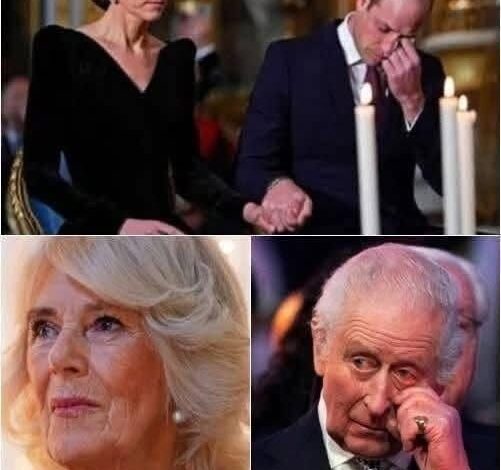
The headline spread quickly, heavy with implication and emotion: a claim that King Charles III had privately apologized to his eldest son, Prince William, for the death of Princess Diana. According to unverified accounts circulating in royal commentary circles, the moment was intimate and unscripted—father and son alone, a hand grasped, a sentence spoken quietly: “I’m sorry, my son. I’m sorry for your mother.”
If true, the weight of such words would be immense. Diana’s death in Paris in 1997 was not just a tragedy; it was a rupture that altered the relationship between the British monarchy and the public forever. Flowers piled outside palace gates. Newspapers questioned the institution with a ferocity rarely seen. Millions mourned a woman they felt they knew personally. For her sons, the loss was not symbolic or historical. It was immediate, brutal, and permanent.
The reported apology, however, exists in a gray zone between rumor and revelation. No official confirmation has emerged from Buckingham Palace. No primary source has stepped forward to validate the exchange. The story has traveled through tabloid outlets and secondary royal commentators, gaining traction precisely because it touches a nerve that has never fully healed.
For decades, speculation has surrounded Diana’s death. The official account—a high-speed crash in the Pont de l’Alma tunnel while being pursued by paparazzi—has been reaffirmed by multiple investigations. Yet public doubt never fully receded. Questions about media pressure, royal estrangement, emotional isolation, and institutional coldness lingered, not as legal accusations but as moral ones. Diana herself spoke openly during her lifetime about feeling watched, constrained, and abandoned within the royal system. Those statements continue to echo whenever her name returns to the headlines.
In that context, the alleged apology is being framed by some as a moment of reckoning. Not an admission of direct responsibility, but an acknowledgment of regret—of decisions made, silences kept, and a marriage that unfolded under unforgiving scrutiny. Supporters of the claim argue that it reflects a man nearing the later chapters of his life, reassessing the past with fewer defenses and more honesty. Critics argue the opposite: that the story feeds conspiracy, distorts history, and unfairly revives pain for those who have already endured enough.
What makes the claim particularly potent is its timing. King Charles ascended the throne after decades of waiting, carrying with him a complicated public image shaped by his relationship with Diana. His reign began under the shadow of that history, even as he sought to emphasize stability, continuity, and duty. An alleged private apology to Prince William would suggest that, behind the formality of monarchy, unresolved grief and guilt still exist.
For Prince William, the story—true or not—touches on a life lived under a microscope. He lost his mother at fifteen, then grew up while the world dissected that loss repeatedly. In adulthood, he has spoken sparingly but sincerely about Diana’s influence, her warmth, and the absence that never quite fades. Any suggestion of a father’s apology inevitably reframes their relationship in the public imagination, inviting interpretations that neither man has publicly endorsed.
The danger lies in how easily such narratives harden into assumed truth. Royal history is already crowded with myths that began as whispers. Without verified evidence, this claim must remain what it is: unconfirmed. Buckingham Palace has stayed silent, as it often does when confronted with speculative stories. Official biographers and historians have long resisted the idea of secret confessions or hidden acknowledgments surrounding Diana’s death, arguing that they oversimplify a complex tragedy and encourage unfounded conclusions.
Yet the reason the story refuses to disappear is simple. It speaks to something deeply human. People want reconciliation. They want to believe that pain is eventually named, that regret is expressed, that families find some measure of peace after years of silence. The image of a father apologizing to his son for a shared, unfixable loss resonates because it mirrors experiences far beyond royal walls.
If the apology never happened, the persistence of the rumor still reveals something important about public memory. Diana remains a moral reference point, a figure through whom questions of responsibility, empathy, and power are filtered. Her story is not frozen in 1997; it is revisited whenever the monarchy evolves, whenever her sons step into new roles, whenever the institution speaks of modernity while carrying old scars.
If, however, such a moment did occur privately, it would not rewrite history or validate conspiracy. It would simply mark a personal exchange between two people bound by loss, navigating the limits of what can be said publicly versus what must remain private. Apologies do not always imply guilt in a legal sense. Sometimes they acknowledge pain without assigning blame.
Until verifiable evidence emerges, the claim should be treated with restraint. It is not a confirmed revelation, nor is it proof of hidden truths. It is a story circulating in an ecosystem that thrives on emotion, ambiguity, and the enduring fascination with the royal family’s inner life.
What remains undeniable is this: Diana’s death continues to shape the monarchy, her sons, and the public conversation nearly three decades later. Whether through confirmed history or unverified rumor, her presence still demands reflection. And perhaps that, more than any alleged apology, explains why stories like this continue to surface—and why they continue to matter.